|
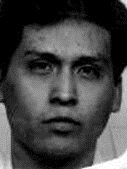
Miguel Flores
Miguel Angel Flores, 31, was executed by lethal injection on 9 November in
Huntsville, Texas for the murder of a 20-year-old woman.
In June 1989, Angela Marie Tyson was closing the Borger video rental store
where she was working that summer when Miguel Flores entered and abducted
her at knifepoint. Flores forced Tyson into her car and took her to a
remote area where he raped her. He then took her back into town, where he
parked the car and talked to her for several minutes. When she began
screaming, Flores stabbed her with a pocket knife six times in the chest and
four times in the back. He then left his victim in her car and fled the
scene.
When Flores learned that police were looking for him, he turned himself in
and confessed to the crime. Court testimony showed that Flores was
infatuated with Angela Tyson and visited the video store frequently on
nights she was working there. He was found guilty of capital murder and
sentenced to death by a jury.
On appeal, Flores' lawyers raised the point that Flores, a Mexican citizen,
was not informed of his right to communicate with the Mexican consulate at
the time of his arrest. Over the next five years, state and federal courts
ruled that although this violated his consular rights under the Vienna
Convention, it did not invalidate Flores' conviction. In 1995, Flores was
set to be executed, but received a stay from U.S. District Judge William
Wayne Justice because of the consular rights question. However, later
appeals verdicts and statements by the U.S. State Department confirmed the
earlier decisions that even though an international treaty was violated, the
federal government had no authority to prohibit a state from carrying out an
execution in such a case.
In the weeks leading up to the execution, the Mexican government appealed to
the U.S. Supreme Court, the State Department, and the Texas Board of Pardons
and Paroles to halt the execution. The Mexican government did not deny
Flores' guilt, but asserted that he would have received fairer
representation, especially during the crucial sentencing phase, if he had
been informed of his consular rights. Prosecutors said that Flores, who
came to the United States when he was four years old, graduated from
American schools, and spoke fluent English, claimed to be a U.S. citizen,
and that this nullified the Mexican government's case.
Another appeal argument had to do with a psychiatrist's testimony which
warned that Flores would be a future danger to society. Flores' attorneys
criticized this testimony because the psychiatrist never interviewed or even
met Flores. Prosecutors said that the psychiatrist could make an accurate
diagnosis based on the facts of the case, so a personal interview was not
necessary. Prosecutors also pointed out that the defense did not allow the
psychiatrist to interview Flores.
On death row, Flores said, "It's something that happened, and it was bad.
I'm very sorry for what I did." "I don't feel I got a fair sentencing
trial," Flores added. "If I had gotten a fair trial and the jury returned
the death sentence, I can accept that. I'm asking for a life sentence, not
to be released."
Two days before the Thursday execution, the Texas parole board denied
Flores' clemency request by an 18-0 vote. The U.S. Supreme Court twice on
Thursday denied his request for an appeal by a 5-4 vote -- once about five
hours before the execution and again with less than an hour to go.
At his hour of death, Flores apologized to Angela Tyson's relatives. "I
want to say I'm sorry. I said a prayer today for you so you can have peace.
I hope you can forgive me," he told them. As the lethal drugs took effect,
he closed his eyes, sputtered, and grunted. He was pronounced dead at 6:22
p.m.

By David Carson. Posted on 14 November 2000.
Sources: Texas Department of Criminal Justice, Associated Press, Reuters, Fort Worth Star-Telegram.
|