
Execution Report: Randall Hafdahl
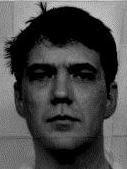
Randall Hafdahl
Executed on 31 January 2002
Randall Wayne Hafdahl Sr., 48, was executed by lethal injection on 31 January in Huntsville, Texas for the murder of a policeman.
In November 1985, a car carrying three men swerved off of a highway and into the back yard of a private residence. The car was driven by Randall Hafdahl, then 32. According to his trial testimony, Hafdahl was drunk and "pretty messed up" from eating hallucinogenic mushrooms. Unable to restart his car, Hafdahl grabbed a pistol and tried to run away.
James D. Mitchell Jr., 42, an Amarillo police officer, had just finished his shift and was driving home, still in uniform. Mitchell saw Hafdahl's car swerve around his truck and watched as it veered off the road. He stopped to investigate. When he saw Hafdahl running away, he ordered him to stop. With his revolver drawn, Mitchell pursued Hafdahl through the yard until Hafdahl was stopped by a locked gate. Hafdahl then turned and killed Mitchell at close range with four shots from his 9 mm semi-automatic pistol. Mitchell never returned fire.
After shooting Mitchell, Hafdahl fled the scene, only to turn himself in later that night. Shawn David Terry, 22, was arrested near the scene of the shooting. Daniel Louis Helgan, 24, was arrested later in New Mexico.
Under Texas law, murder of a police officer in the line of duty is a capital offense, but only if the killer knows that the victim is a police officer.
At his trial, Hafdahl admitting shooting Mitchell, but said he did not know he was a policeman. He said that he only tried to leave the yard in the first place in order to get to a telephone to call a wrecker. When he heard a voice behind him, he turned and saw a man with a gun. Fearing for his life, he shot him four times in rapid succession. He said he only realized Mitchell was a policeman as he was falling to the ground. He said that Mitchell was wearing a windbreaker that concealed much of his uniform.
The prosecution, however, depicted the killing as one that Hafdahl committed knowingly. They said that Hafdahl's first shot hit Mitchell in the wrist and disarmed him, then he continued to advance on the uniformed officer and pump rounds into him while he was on the ground.
The question of whether Hafdahl knew Mitchell was a policeman centered around three questions: 1) Was Mitchell visually identifiable as a policeman? 2) Did Mitchell verbally identify himself as a policeman? 3) Did Hafdahl see or hear Mitchell before shooting him?
The prosecution offered substantial evidence that Mitchell was visually identifiable as a policeman. They pointed out that Mitchell's police-issue windbreaker was marked, "Amarillo City Police" and bore a badge insignia. At least eleven witnesses, including Terry and Helgran, testified that they recognized Mitchell as a policeman from his uniform.
The prosecution also presented witnesses who testified that they heard Mitchell yell, "stop, police!" and similar warnings. The most hotly disputed question, therefore, was whether Hafdahl saw or heard Mitchell before shooting him. Hafdahl himself testified that his senses were numbed from the drugs and alcohol in his system. He heard someone yelling at him, but he couldn't understand, and wasn't even sure whether the man yelling at him was the same man who was chasing him, or one of his companions.
Shawn Terry testified that he saw Hafdahl shoot Mitchell four times in rapid succession. Daniel Helgran testified that he was removing the license plate from the wrecked vehicle when the shots were fired. He also said in a sworn statement that the shots were fired in rapid succession. The prosecution, however, used the testimony of Dr. Ralph Erdmann, a forensic pathologist, to reconstruct the crime. Erdmann testified that based on the distance and angle from which each shot was fired, only one shot -- the one in Mitchell's wrist -- could have been fired when Mitchell was standing. The other three, including the two fatal ones through the heart, were fired when Mitchell was already down. In addition, the prosecution brought four witnesses who said that they saw Hafdahl turn and look at Mitchell before shooting him.
Hafdahl had a previous conviction for delivery of LSD. He received a sentence of ten years' probation. Testimony at the punishment phase of his trial indicated that Hafdahl had previously overseen a methamphetamine production operation in Colorado. He had also been charged with aggravated kidnapping and had a warrant out for his arrest at the time of Mitchell's killing. He had dyed his hair and began using the aliases Robert Moore and Jack Douglas Cone. Prosecutors said that Hafdahl knew that if he was caught by Mitchell, he would be arrested and tried for kidnapping.
Continued on Page 2