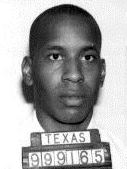
Henry Dunn
Henry Earl Dunn Jr., 27, was executed by lethal injection on 6
February 2003 in Huntsville, Texas for the abduction, robbery, and
murder of a 23-year-old man.
In November 1993, Donald Aldrich, 29, Henry Dunn, then 19, and David
McMillian, 17, drove to a city park that was known as a meeting place
for homosexuals. At the park, Aldrich spotted Nicholus West, 23. He
got out of their car and approached West, who was in his pickup.
Aldrich pretended to be interested in West, and West invited Aldrich
to join him. The two drove together to a nearby parking lot. Dunn
and McMillian followed in their car.
Once in the parking lot, the three men brandished weapons at West and
forced him into their car. With Dunn holding a gun on West, McMillian
drove them to a clay pit about ten miles outside of town. Aldrich
drove West's pickup. When they arrived, the trio walked West away
from the road, into the pit. They made him remove his pants and shoes
and stole his wallet. They then shot him 9 to 15 times and left his
body in the pit, face down. They then left the scene, with Aldrich
driving West's truck and McMillian and Dunn in their car. West's body
was discovered by dirt bikers two days later.
Dunn was arrested in posession of West's pickup. He gave a videotaped
confession in which he admitted firing the first shot. He said he
fired his gun in the air, and the others began firing their guns at
West. Dunn also said that he fired at West from four to six times and
that one of his shots probably hit West in the head. After his
arrest, Aldrich told police that he and his accomplices went to the
park on the night of West's murder with the intention of finding
homosexuals to assault.
Evidence presented at Dunn's trial showed that he used a .357 Magnum
and that matching bullets were found in the victim's body, including
one in his head. Dunn had no prior felony convictions, but he had
been arrested three times for assault and aggravated robbery. In each
case, the charges were dropped.
A jury convicted Dunn of capital murder in August 1995 and
subsequently sentenced him to death. The Texas Court of Criminal
Appeals affirmed his conviction and sentence in September 1997. All
of his subsequent appeals in state and federal court were denied.
Donald Loren Aldrich had prior convictions for burglary and robbery.
He was also convicted of capital murder and sentenced to death. He is
currently on death row, with his case going through appeals.
David Ray McMillian was convicted of aggravated robbery and aggravated
kidnapping and received a life sentence.
Smith County District Attorney Jack Skeen, whose office prosecuted all
three defendants, said that they were members of a group called the
"CB gang", so named because they became acquainted over citizen's band
(CB) radios. The gang, supposedly led by Aldrich, carried out other
attacks on homosexual men in the Tyler area over a period of months.
Dunn was one of seven Texas death row inmates who attempted to escape
the Ellis Unit in Huntsville on Thanksgiving Day 1998. He and five
others surrendered after prison guards fired shots at them. Inmate
Martin Gurule escaped, but was fatally shot and was found drowned in a
nearby river. Following the escape, death row was moved to the new
Terrell Unit (later renamed to the Polunsky Unit) in Livingston.
Dunn is the third participant in the escape to be executed. James
Clayton and Ponchai Wilkerson were executed in 2000. Howard Guidry,
Eric Cathey, and Gustavo Garcia remain on death row.
In death-row interviews, Dunn admitted to being at the West murder
scene, but denied being responsible for the man's death. "I didn't
pick him up. I'm sad it happened, but I still don't think I'm
responsible for the actual shot that killed him - I never got that
close," Dunn said in 2002. "Nicholus West was still alive at the time
we left."
In an interview the day before his execution, Dunn further distanced
himself from the crime. "I didn't kidnap Nick West. Donald Aldrich
did," he said. "He was already kidnapped, I guess you could say, when
we [Dunn and McMillian] showed up." He also denied that West was
murdered because he was homosexual. "I don't hate homosexuals," Dunn
said. "That's their right to be that way if they want to." According
to Dunn, the murder was the result of a robbery gone wrong. "West
told [Aldrich] he'd given him all the money he had," Dunn said. "We
started walking up a trail, and Aldrich finds some money while he's
walking. West says he doesn't know whose it is. That's when everything
got out of hand ... Aldrich was mad because the dude didn't give him
all his money."
Dunn received a reprieve of a 2002 execution date from the U.S. Fifth
Circuit Court of Appeals. He had claimed that his trial counsel was
incompetent. The Fifth Circuit heard and rejected Dunn's claims in
August, clearing the way for his execution to be rescheduled.
"Every day I wake up, I know why I'm on death row," Dunn said. "I've
several times apologized to [West's] family and hoped they'll forgive
me. But my death won't bring him back."
In his last statement at his execution, Dunn expressed love to his family. He then told the victim's relatives, "I hope you can find it in your heart to find forgiveness and
strength, to move on and find peace."
his execution. The lethal injection was then started, and Dunn was
pronounced dead at 6:15 p.m. Dunn also left a written statement,
which was released after his death. It complained about the Texas
death penalty, calling it a "broke and unfair" system.

By David Carson. Posted on 10 February 2003.
Sources: Texas Department of Criminal Justice, Texas Attorney General's Office, Associated Press, Huntsville Item, Tyler Morning Telegraph.
|