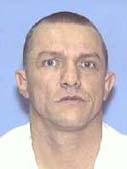
Robert Morrow
Robert Brice Morrow, 47, was executed by lethal injection on 4
November 2004 in Huntsville, Texas for the abduction and murder of a
21-year-old woman.
On 3 April 1996, Lisa Allison left her parents' home in Liberty to
take her father's car to a car wash. She did not return. A fisherman found her body was found the next morning, floating in the Trinity River. Her throat had been cut, and she had been severely beaten. The autopsy indicated that she died from a combination of several skull fractures and a severed jugular vein.
Allison's car was also found. Hair and blood samples taken from the car matched Morrow, who lived about two miles from where the car was found. Allison's blood was also found in the car.
Morrow was arrested on 29 July. At his trial, a friend of his, Dane
Schisler, testified that he dropped Morrow off across the street from
the car wash shortly before Allison disappeared. Brad Keaton, another
acquaintance, testified that he saw Morrow walking down the road that
night. Keaton testified that Morrow had scratches on his arms and a
considerable amount of blood on his clothing. Morrow told Keaton that
he had been in a car wreck.
Bryan McNeill testified that he was cleaning his truck at the car wash
on 3 April, and he saw Lisa Allison there. After he finished
vacuuming, he pulled his truck to a pump at the gas station next to
the car wash. He then saw a car across the street let out a man on
the side of the road, and the man proceeded to walk toward the car
wash. A short time later, McNeill heard a short scream come from the
car wash. He saw the man laying on top of Lisa Allison in the
passenger side of her car. He then watched as the man got up and
Allison slid behind the steering wheel. The man sat down in the
passenger seat, and the two drove off in the direction of the Trinity
River. McNeill testified Allison did not appear to be struggling, so
he reasoned that she and the man were girlfriend and boyfriend, and
the short scream he heard was unimportant. McNeill testified that he
did not get a good look at the man's face, nor did he see his hands at
any time, but McNeill's physical description of the man did match
Morrow.
A co-worker of Morrow's testified that Morrow had told him prior to
the murder that it would be easy to abduct a woman from a service
station and take her money and jewelry. Morrow added that he would
also have sex with her, and then "take care of her."
Morrow testified that he had nothing to do with the crime.
Morrow had a previous conviction for forgery and was sentenced to five
years' probation. After violating the terms of his probation, he was
sentenced to 30 months in prison. He served 20 months of that sentence
from 1981 to 1983 before being released. Morrow also had served time
in Louisiana and South Carolina for burglary, grand larceny, and
carrying a weapon illegally. He also had misdemeanor convictions for
marijuana possession, marijuana delivery, and failure to identify a
fugitive.
A jury convicted Morrow of capital murder in November 1997 and
sentenced him to death. The Texas Court of Criminal Appeals affirmed
the conviction and sentence in June 2000. All of his subsequent
appeals in state and federal court were denied.
Four days before his scheduled execution, Morrow told a reporter that
Allison went willingly with him from the car wash to smoke crack
cocaine. As they were driving down an isolated road near the Trinity
River, Allison's car got a flat tire. She became upset with him for
not changing the tire quickly enough, he said, and she stabbed him in
the leg with a screwdriver. "I'm high on cocaine, and it blew my
fuse," Morrow said. "So, I knotted up and slapped her and beat the
(expletive) out of her." She then ran from him, so he chased her and
dragged her back to the car, throwing her in the trunk so he could
change the tire. "When I opened the trunk again, she came at my like
a raving ... maniac. So, I had to whop her upside the head with a jack
handle."
Lisa Allison's father was a Liberty city councilman, and she had
relatives in local law enforcement, including a cousin who was a
deputy sheriff. "I knew who her family was," Morrow said. "I was a
convicted felon that had been to the pen three times. I didn't have a
snowball's chance in hell. I did what I had to do." He then cut
Allison's throat. "I wish it didn't happen, but I can't change it,"
he said. "When you do drugs, there's no telling what can happen. I
did that night, and it got out of hand."
Morrow said that he should not be executed for Allison's murder
because he did not kidnap her. By law, only murder cases that include
an aggravating factor, such as kidnapping, are eligible for the death
penalty.
Liberty County District Attorney Mike Little called Morrow's account
"totally preposterous." He said that tests found no trace of any
drugs in the victim's system at the time of her death. He said that
Morrow was attempting to manipulate the system by smearing the
family's memory of Lisa.
Morrow told a Houston Chronicle reporter that he had arranged for his
ashes to be sent to family members in Ireland, but "I want you to tell
the Allison family that I have arranged for a friend to get my ashes
and scatter them over their daughter's grave," he said with a loud
laugh.
Morrow said that he was ready to die. "I'd have to be retarded or
stupid to want to live on death row," he said. "They're doing me a big
favor. I'm getting set free."
Morrow's execution was delayed briefly as prison workers had
difficulty finding suitable veins to use for the lethal injection.
At his execution, Morrow addressed Lisa's parents by name and said, "I
would like to tell you that I am responsible and I am sorry for what I
did and the pain I caused." He also expressed love to his friends. He
then said, "Set me free, warden. Father, accept me." As the lethal
injection began flowing, Morrow turned again to the Allisons and said,
"I do hope my death brings you all some closure." He then blurted out,
"I feel it," and gasped slightly three times. He was pronounced dead
at 6:35 p.m.

By David Carson. Posted on 5 November 2004.
Sources: Texas Attorney General's office, Texas Department of
Criminal Justice, court documents, Associated Press, Beaumont Enterprise, Houston Chronicle.
|