|
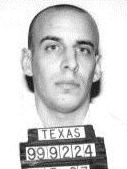
Richard Cartwright
Richard Michael Cartwright, 31, was executed by lethal injection on 19
May 2005 in Huntsville, Texas for the robbery and murder of a
37-year-old man.
On 1 August 1986, Cartwright, then 22, was out with two friends -
Dennis Hagood, 19, and Kelly Overstreet, 18 - in Corpus Christi. When
Nick Moraida pulled up in a black sports car, the trio, posing as
homosexuals, invited him to go drinking with them at a seaside park.
Moraida agreed, and the four drove off together. They parked in a
cul-de-sac and walked down a hill to the seawall. The men then robbed
Moraida of his wallet, keys, watch, and an envelope containing cash.
Moraida's body was discovered near the seawall the next day by
fishers. His neck was cut, and he had been shot in the back with a
.38-caliber pistol. At Cartwright's trial, the medical examiner
testified that the knife wounds were not fatal, and that the gunshot
wound was the cause of death.
Overstreet and Hagood testified against Cartwright and claimed he was
responsible for Moraida's death. According to their testimony, when
they had Moraida by the concrete seawall, Cartwright pulled out a
pistol and told him, "This is a robbery. Put your hands on
the cement." Overstreet then held a knife to the victim's neck. They
robbed him, then Overstreet then cut Moraida's throat, and Cartwright
shot him in the back.
Cartwright had a prior felony conviction for unlawful possession of a
controlled substance. He was sentenced to two years' probation in
February 1990.
A jury convicted Cartwright of capital murder in 1997 and sentenced
him to death. The Texas Court of Criminal Appeals affirmed the
conviction and sentence in May 1999. All of his subsequent appeals in
state and federal court were denied.
Kelly Overstreet and Dennis Hagood were sentenced to 50 and 20 years
in prison, respectively.
On death row, Cartwright declined to be interview by reporters,
preferring instead to write letters to anti-death-penalty
organizations, who posted his letters on their web sites. "I did not
commit the crime for which I was convicted and sentenced to death," he
stated. His claim of innocence, however, revolved around his
responsibility for the murder, not his involvement in it. Cartwright
blamed Overstreet for the murder, without elaboration.
To support Cartwright's claim that Overstreet was responsible for the
murder, the web sites linked to a handwritten letter Overstreet wrote
his girlfriend while in jail awaiting trial. In the letter, he wrote,
"I sometimes do things I don't really mean to do, I usually do these
things when I am high. I have always hated faggots but I didn't mean
to kill the little 'queen.' I was pretty high that night, and I guess
my rage overcame my ass. I guess that is what being a skinhead is all
about."
In a recent written statement to Cartwright's lawyers, Overstreet
stated, "I intentionally made Cartwright out to be the bad guy out of
spite when in fact I am the one who was at the forefront of all
events." Cartwright's lawyers tried to have his execution stayed,
claiming that he was convicted on false testimony. Though they did not
deny that Cartwright shot the victim, they claimed that he was under
duress, following Overstreet's orders because he was afraid of him.
The U.S. Supreme Court rejected Cartwright's appeal late in the
afternoon of his execution.
Attorneys for the state said that Overstreet's statements were
unreliable and did "nothing to establish actual innocence" or
undermine Cartwright's culpability.
"I want to apologize to the victim's family for any pain and suffering
I caused them," Cartwright said in his last statement. He also
encouraged his fellow death row inmates to "just keep your heads up
and stay strong." The lethal injection was then started. He was
pronounced dead at 6:16 p.m.

By David Carson. Posted on 20 May 2005.
Sources: Texas Attorney General's office, Texas Department of
Criminal Justice, Associated Press, Huntsville Item, www.deathrow.at.
|